INFECTION
PREVENTION & CONTROL
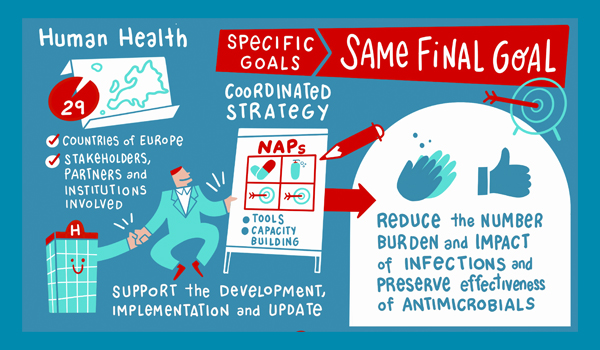
EU-JAMRAI 2 works on improving the Infection Prevention and Control (IPC) actions with a One Health Approach. The goal is to strengthen IPC networks, knowledge sharing and strategies across Europe and to promote a strong connection between policy, standards, available guidance and recommendations through enhancing collaboration with authorities and stakeholders across human, veterinary and environmental health sectors in the field of IPC.
The activities are designed to facilitate the implementation of prioritized IPC actions. This includes supporting the development and implementation of core elements and competencies for IPC across various settings, and by working together with AMS initiatives our actions aim at ensuring a unified and effective approach to protect humans, animals and our environment from AMR.
As part of the EU-JAMRAI 2 IPC capacity building activities, we are doing activities that promote knowledge sharing and the development of best practices. This will be done in different ways, e.g. through peer-to-peer activities and expert forums. Behavior change science to support the implementation of IPC practices at different levels of the healthcare systems is an essential a part of the EU-JAMRAI 2 IPC activities.
How does the Infection Prevention and Control work in EU-JAMRAI 2 support the implementation of the EU Council recommendations of AMR?
EU-JAMRAI 2 has the opportunity to serve as a link between policy and implementation. A key policy document directing our work is the 2023 Council Recommendations on stepping up EU actions to combat antimicrobial resistance in a One Health approach.
The infection prevention and control work of EU-JAMRAI 2 support the following recommendations:
- Education, awareness and training of professionals working in human health, veterinary, environmental and agronomy sectors on AMR, on infection prevention and control and on the One Health approach play an important role in the fight against AMR, due in particular to their roles as advocates for prudent antimicrobial use and educators of patients and farmers (….) (23)
- Strengthening infection prevention and control in healthcare settings and long-term care facilities through: ensuring core competencies, development of appropriate guidelines, training activities (….) (C7a)
- Ensuring continuous training regarding knowledge on infection prevention and control for all personnel in the community, hospitals and long-term care facilities, with the help of pedagogical and behavioural insights (C7d)
- Ensure adequate coordination between infection prevention and control and antimicrobial stewardship programmes (C7f)
- Take measures to improve the health and welfare of food-producing animals in order to decrease the occurrence and spread of infectious diseases in farming and subsequently reduce the need for antimicrobial use, in particular by: encouraging veterinarians to advice farmers on IPC measures, encouraging uptake of biosecurity and IPC measures, ensuring continuous training on IPC and biosecurity (…) (C8)
- Develop, in coordination with ECDC, EU infection prevention and control guidelines in human health care, taking into account a cost-effective approach, notably for hospitals and long-term care facilities. When developing these guidelines, international guidelines should be taken into account and close collaboration with European and national professional societies should be ensured (C10)
- Providing professionals working in human health care, veterinary and agronomy sectors with regularly updated information (….) as well as information materials on AMR and the importance of effective infection prevention and control, environmental risks, biosecurity (…) (F24a)

IPC in Human actions
EU-JAMRAI 2 works to support the wider uptake of state-of-the-art IPC for both the community acquired and healthcare-associated infections in various settings. An essential part of the IPC human health activities is to stimulate networking and knowledge sharing between all stakeholders in the field of IPC.
Highlights:
- Face-to-face meeting in Barcelona, December 2024: “Implementation of IPC in Human Sector”. A meeting for all partners engaged in human IPC activities
- Quarterly webinars to address specific scientific topics in infection prevention and control has been launched. Video recordings are to be found on under Education and Training.
- A pilot project template has been designed to reach a structured approach to IPC implementation projects. Followed by a shared repository of filled out project templates for inspiration and exchange of practices.
- Blood cultures, EU standards on IPC: A set of recommendations has been developed in collaboration with the ECDC. This output will form a key evidence base for the forthcoming EU Infection Prevention and Control Guidelines in Human Health, which are scheduled for publication in 2026.
- EU Framework for implementation of IPC core competencies: Recommendations for changes to the ECDC´s technical 2013 document on IPC core competencies has been developed. This output will form the basis for an update of the current EU guidance on IPC core competencies for IPC professionals. The recommendations has been developed in collaboration with partners in the EU-JAMRAI 2 project and an advisory group of European IPC experts. A questionnaire survey has provided quantitative and qualitative data for the report.
- Infection case definitions of HAI in European Surveillance Systems: A review with the goal of identifying and analysing the Healthcare-Associated Infection (HAI) case definitions used in country-owned surveillance systems across Europe. Analysis of harmonisation with ECDC definitions and recommendations for a better benchmarking.
Progress Year 1 and 2 (2024-2025)
The first year has laid a solid foundation for the project, establishing its operational framework and strategic objectives. Engaging our partners has been one of our main attentions in year 1. Also, an Advisory Board for IPC outputs has been established to streamline engagement and ensure cohesive IPC recommendations from EU-JAMRAI 2 for the EU context. Our key achievements focus on shaping EU-wide standards and supporting frontline IPC personell in implementing IPC recommendations.
The main progress is described below:
Face-to-face meeting in Barcelona
Title: “Implementation of IPC in Human Sector”. A meeting for all partners engaged in human IPC activities. Key stakeholders and collaborators represented were: WHO, ECDC and EUCIC. The workshop contributed to a common understanding of the EU-JAMRAI 2 IPC tasks and included workshops on IPC training, IPC tools, a structured approach to perform pilot projects and adaptation of blood culture indication to the EU context. Networking and getting to know each other were an essential part of the meeting, which also included presentations from countries on how to implement IPC. See the agenda.
Defining EU standards in IPC
In close collaboration with the ECDC, documents on core competencies for IPC and Diagnostic Stewardship in Blood Cultures were developed. Furthermore, the review and update of the ECDC guidelines directory is underway, alongside the mapping of case definitions for Healthcare-Associated Infections (HAIs) across European national surveillance systems. These outputs will form a key evidence base for the forthcoming “EU Infection Prevention and Control Guidelines in Human Health,” scheduled for publication in 2026.
Providing an EU Framework for implementation of core IPC competencies
Also, in close collaboration with EU-JAMRAI 2 partners and ECDC the available European recommendations for IPC competencies have been evaluated. The evaluation was based on a survey with questions divided into three parts:
- Knowlege and use of the ECDC 2013 document
- IPC legislation and training
- Challenges and needs
Parallel to this, a Self-Assessment System (SAS) is being developed in collaboration with EU-JAMRAI 2 partners and the WHO. The SAS will be used for assessing the degree of IPC core competencies at junior and senior level at local and national level in the healthcare facilities. The version 1.0. is planned to be piloted in partner countries winter 2025/2026. As a part of the work a survey on the use of SAS in the EU has been performed.
Supporting implementation of IPC core components at national and local level
To provide a comprehensive European overview, a mapping of IPC tools was conducted, identifying 25 unique resources from 16 countries and outlining their effectiveness and unmet needs.
The blueprint for the INSIGHT Digital Platform, a dedicated EU hub for uploading IPCAF self-assessments, aggregating data, and enabling peer-to-peer exchanges, was finalized in early 2025. The first detailed design proposal is currently in preparation, incorporating feedback from project partners.
A repository of pilot projects was established in June 2025 and currently hosts 10 country-led initiatives. This repository serves as a platform for partners to share practical approaches and best practices for IPC implementation.
To ensure targeted progress, individual meetings are being conducted with all participating countries to provide tailored support for their specific implementation plans, projects, and tasks.
Establishing a peer-to-peer (P2P) programme
An IPC P2P programme including a Q&A hub, educational sessions, peer-to-peer exchanges, mentorship and observership activities is under development. The programme will be developed and implemented in collaboration with EUCIC (The European Committee on Infection Control).
An opportunity to book an individual online mentorship meeting is now open: [Access to the request form]
Spring 2025, a Needs Assessment Survey exploring the needs from partners and the wider network of IPC European professionals regarding topics in demand, challenges in their daily work and expectations regarding the methods to use for facilitating the exchanges and connections between peers and experts was carried out. [Access to the needs assessment form]
In 2025, quarterly webinars to address specific scientific topics in IPC depending on the partner’s needs has been launched. Video recordings are to be found on under Education and Training.
IPC in Animal Actions
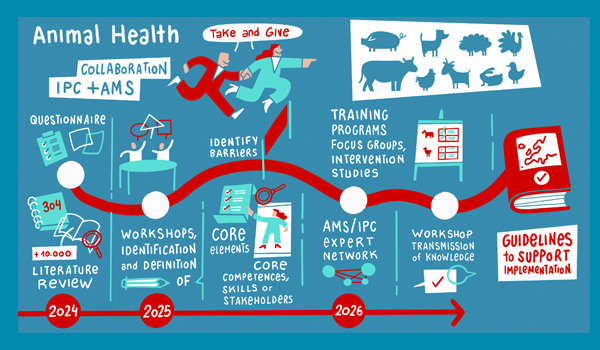
- Develop an EU-JAMRAI expert network on IPC/biosecurity in animal healthcare to perform a comprehensive review of veterinary IPC protocols, practices, and diagnostic tools.
- Identify key components of EU-standards for IPC/biosecurity in veterinary medicine according to animal species and husbandry across EU countries.
- Determine key health and biosecurity measures in animal husbandry to reduce AMC at the farm level.
- Create educational programs to facilitate knowledge dissemination and information exchange between IPC professionals.
Progress Year 2 (2025)
Joint Workshop on AMS & IPC/biosecurity
- Held on 11 March in Bilbao, jointly organised by WP6.2 and WP7.2. [Download the workshop report]
- Participants included representatives from countries and key stakeholders (e.g. WOAH, FAO, ECDC and DG Sante).
- The workshop contributed to identifying core elements and competencies in AMS and IPC.
- A detailed report with conclusions, along with supporting materials and photos, is available on the JAMRAI website
Webinar Series “VOICES FROM THE FIELD”
- Launched in autumn 2025 in collaboration with WP6.2
- Experts from across Europe share their hands-on experiences with implementing AMS and IPC in animal health.
Focus groups with veterinarians
- Currently being organised across different sectors (cattle, poultry, pigs, companion animals).
- Aim is to gather insights from veterinarians on the actions taken and barriers experienced regarding antimicrobial use (AMU) and the implementation of biosecurity/IPC measures for various infectious diseases relevant to AMU and AMR
Progress Year 1 (2024)
During the first year, the primary focus was on collecting and analysing existing information on IPC guidelines, protocols and tools in the animal health sector. The following actions were carried out:
Joint Survey in collaboration with WP 6.2 (AMS in animal health)
- Collected 30 responses from 17 different countries.
- A working group with 7 partners from 6 countries analysed the data and evaluated the IPC/biosecurity tools and practices.
- Results were consolidated in a report summarizing data on existing IPC guidelines and tools used in the European context of animal health.
Comprehensive literature review
- Conducted on IPC guidelines in both food-producing and companion animal sectors
- The review is ongoing and expected to be finalised in Year 2, leading to a report and a scientific publication.
IPC in the Environmental sector
Objectives
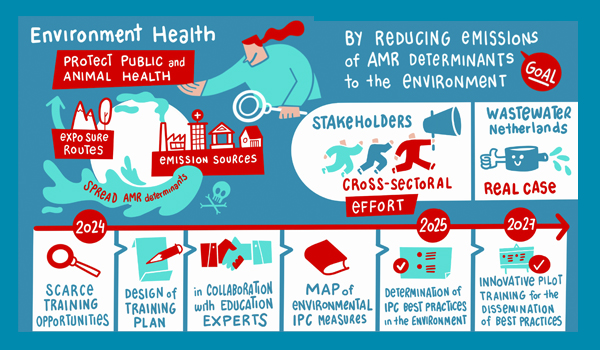
- Map existing interventions that reduce emissions of AMR, directly or indirectly, resulting from human and animal activities to the environment across participating countries (e.g. advanced wastewater or manure treatment methods)
- Identify and evaluate country best practices for potential implementation across Europe.
Key achievements
- A survey has been developed by a working group containing technical, financial, operational, governance and regulatory aspects on environmental interventions at country level, including definitions of such interventions and contextualization with current EU legislations.
- Identification of and dissemination to target respondents across public and private sectors was initiated by each country, including governments, national agencies, professionals, scientific community and industries, among others.
Outcome(s)
- Results of the survey are expected in fall 2025, contributing to a list of innovative measures to reduce emission of AMR to the environment across member states.
- Increased awareness about the emission of AMR and antibiotic residues into the environment via (the use of) waste streams.
- Good collaborations across all environmental work packages of JAMRAI.
Next steps
In dept evaluation of the results of the survey and literature review concerning efficiency of example measures and interventions stemming from the survey.
EU Council Recommendation
Our work is in line with EU Council recommendations on good evidenced based practices for waste management (manure and wastewater) to reduce environmental exposure to antimicrobial substances and AMR determinants.
Behaviour change strategies for IPC
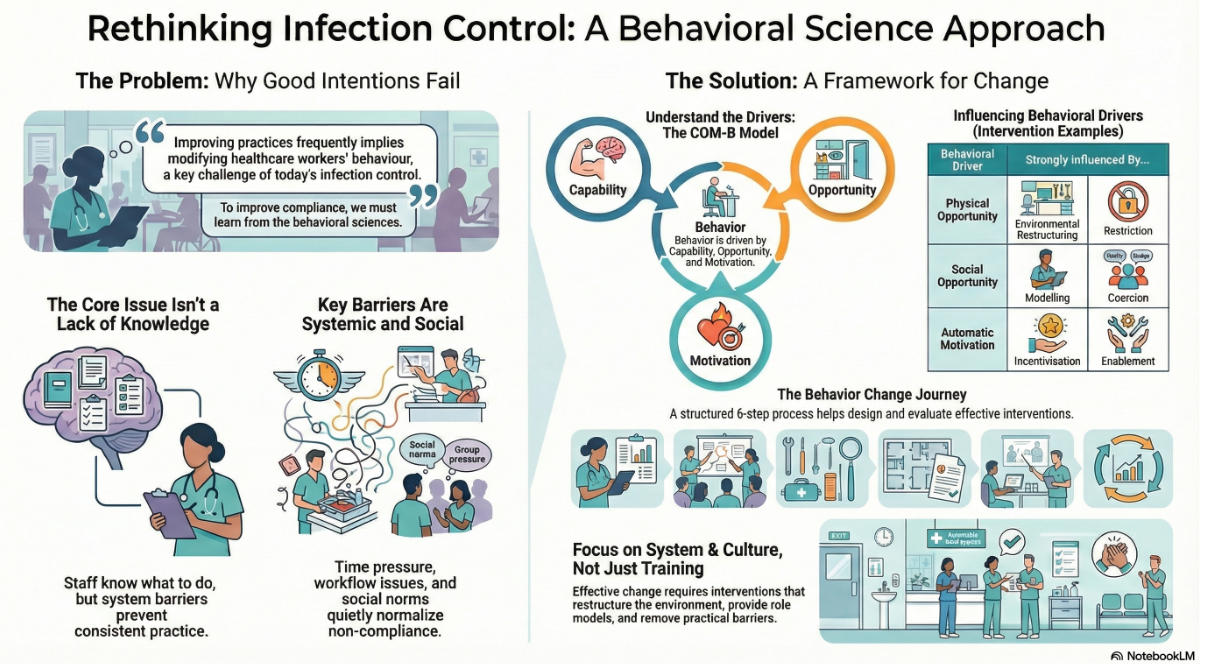
Work Package 7.4 focuses on embedding behavioural science into infection prevention and control (IPC) by supporting partner healthcare institutions across the Europe to design, implement and evaluate context-specific behaviour change interventions that strengthen day‑to‑day IPC practices.
The work package builds upon the recognition that technical solutions like guidelines and education alone are insufficient. Rather, sustained improvement requires understanding why behaviours occur, and how to support frontline staff to adopt safer and more consistent IPC routines.
Objectives
- To support partners in using behavioural science frameworks, including TDF (Theoretical Domains Framework) and COM‑B (Capability, Opportunity, Motivation – Behaviour), to identify factors influencing IPC behaviours.
- To use these insights to inform the co‑design and piloting of tailored behaviour change interventions tailored to each participating organisation, with an emphasis on feasubility, sustainability, and real-world implementation.
- To generate shared learning across European countries on the drivers, barriers, and enablers of IPC behavioural change.
Key Activities and Progress
- Establish national coordination teams who will recruit pilot healthcare institutions across participating countries.
- Build capacity in behavioural science for IPC among the participating partners through a two- day Behaviour Change Workshop in Malta (October 2024), delivered in hybrid format to ensure broad participation. The workshop provided a shared foundation in behavioural drivers of IPC performance, behaviour change principles, TDF and COM-B frameworks, and intervention planning.
- Identify an IPC related behaviour in each participating pilot location that will be addressed during the project
- Conduct structured behavioural diagnostics using tailored TDF-based surveys and interviews aiming to identify key barriers and enablers influencing selected IPC practices at hospital level.
- Strengthen cross-country learning through a second in-person Behaviour Change Workshop in Helsinki, with a specific focus on completing the main diagnostic phase, interpreting survey findings, exploring organisational culture influences, and translating behavioural insights into practical IPC intervention components.
- Design and refine context specific IPC behaviour change interventions that are informed by diagnostic findings and COM-B analyses.
- Explore and integrate organisational culture assesments through the development of an organisational culture factor survey to capture contextual features of hospital settings and inform tailoring and implementation of behaviour change interventions
- Providing ongoing support through one-to-one meetings between WP coordinators and national teams to refine target behaviours, validate identified barriers and enablers, confirm priorities, and agree on implementation timelines.
- Facilitate continued cross-country knowledge exchange through activities including a dedicated side events at Annual General Meetings and other online meetings to compare results and discuss challenges and opportunities.
- Disseminate progress and key insights through EU-JAMRAI communication channels, promoting visibility and engagement among European IPC Stakeholders
Expected Impact
WP7.4 aims to deliver a replicable, evidence‑based model for embedding behavioural science into IPC programmes. By understanding what drives frontline practice and designing interventions that reflect real‑world constraints and motivations, the work package will contribute to more sustainable, person‑centred IPC improvements across European health systems.